
Kurdus Dahi Handi: Where Govindas Leap into a Well
My Pictures of Kurdus Dahi Handi Photography
See my pictures of Kurdus Dahi Handi in better resolution here.
(for computer users)A remarkable tradition in a small Raigad village—and a fascinating photographic opportunity
It's been years since I have made a blog. The experience I had during the Dahi Handi celebration in Kurdus compelled me to write this. What happened differently here?
I have spent more than 25 years shooting in rural India and this is one of my most amazing experiences. Pictures are always by-products, but what I really carried back with me was the love and warmth of the villagers. They treated us literally like Atithi Devo Bhavah.
We reached the village quite early. Whenever I go for any festival, I try to go much before time just to understand the place, talk to people and look for vantage points.
We didn’t have to wait much before the festivities started.
After taking a few pictures of the kids jumping into the water and playing with balloons, we went to the one of the houses where the festival begins with Aarati.
The tradition is that all the villagers go from house to house. They are welcomed with sweets and savories. Many houses also have a handi for them to break. Most of these handis are kept low and are mostly done by kids. So, instead of shooting just one handi, you will get an opportunity to shoot multiple handis.
Kids dressed as Krishna and Radha and their mates are made to sit in a decorated bullock cart and cart moves through the narrow lanes of the village.
There are several teams in the villages and each team wears the same t-shirt. Even the ladies wear the same saarees.
What is special about Kurdus Dahi Handi?
Everywhere else in Maharashtra, Dahi Handi is synonymous with human pyramids.
Govindas climb onto one another's shoulders, layer after layer, trying to reach a clay pot suspended high above the ground. The higher the pyramid, the greater the spectacle—and, often, the greater the risk. Every year, many fall down and get injured.
Here in Kurdus, there is no pyramid.
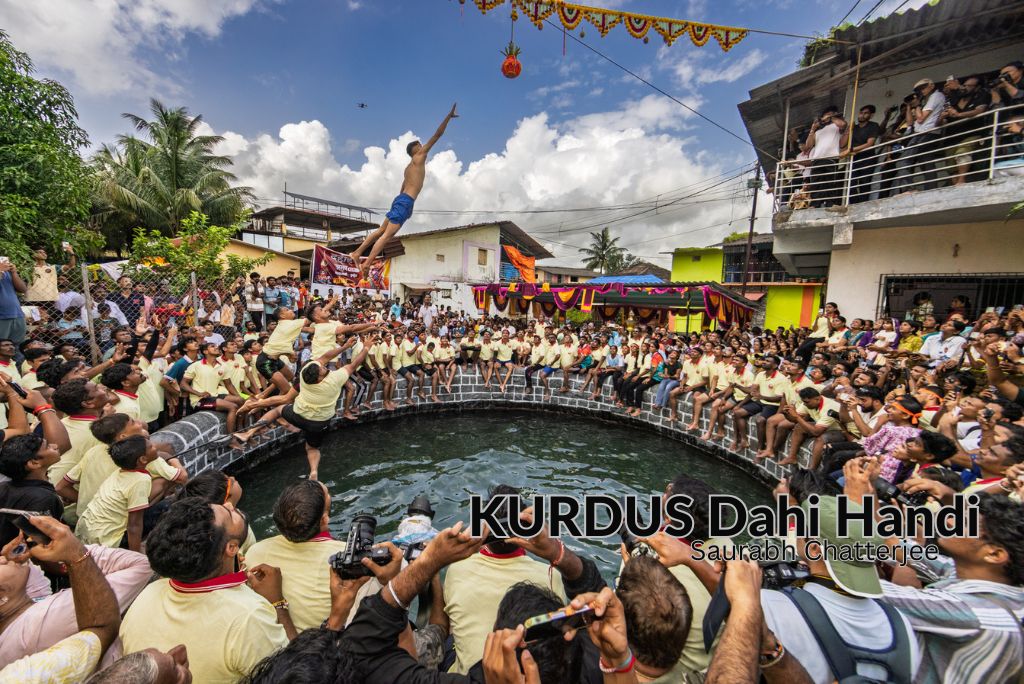
Instead, there is a large, old village well, a Dahi Handi suspended above its centre—and a Govinda who launches himself into the air after standing on three peoples as a base, reaches for the handi and then plunges into the water below.
Kurdus, in Alibag taluka of Maharashtra's Raigad district.
For a photographer, it is an extraordinary spectacle.
The well was constructed in 1954 through shramdan—voluntary labour by villagers. It is approximately 40 feet deep and about 40 feet wide, and its water is used by villagers throughout the year.
That makes the setting particularly interesting. The same structure that serves an ordinary, practical purpose for the village becomes the centre of an extraordinary annual spectacle.
Before Dahi Handi, villagers collectively prepare the site: the well is cleaned, its walls are painted and decorated, the water is cleaned and the handi is prepared.
The whole village is extraordinarily clean, no garbage around.
A tradition that began with farmers
The documented history of the present form of the tradition goes back to 1991.
The tradition began among several local farming families as a simple, enjoyable village activity.
The challenge gradually evolved into what we see today: Govindas jumping from the well's parapet towards a handi suspended above the water.
Three participants form the base and use their hands to launch the fourth—the jumper—upwards and towards the handi.
The jumper's objective is not necessarily to smash the pot.
Touching the handi is enough to win.
This is an important distinction for photographers.
The Govinda launches himself from the well's edge, reaches upward towards the suspended handi and lands in the water of a roughly 40-foot-deep well.
The well itself is reported to be approximately 40 feet across, giving the jumper considerable room to land in the water rather than on the wall.
More than 100 attempts
The event is not over in a few dramatic jumps.
It is a long sequence of attempts.
More than 100 people across different age groups take turns each year. The celebration generally begins around noon and continues until approximately 3–4 pm.
That is actually excellent news for a photographer. You don't have to get the picture in the first five minutes. You have repeated opportunities to learn the movement and capture it.
Also, sometimes, the jumper chooses a different position, so can shoot the event with different backgrounds and positions.
The 2026 winner
The 2026 winner was Harsh Pingle.
His victory ended a remarkable run by Akash Pingle, who had reportedly broken the handi for eight consecutive years.
Where should a photographer stand?
Choose your position based on what background you want and from what direction the light is coming. Since the same action will happen multiple times, it will be a good idea to move around rather than sticking to one place. I made the mistake of not moving around, so I have pictures from only one place.
Some shots from close to the well might get you some intimate shots. Also, some from the first floor of a building next to the well.
What focal lengths to use?
15-30mm and 24-70mm (35mm format) is enough to cover everything. A 15mm focal length is particularly important if you want to cover the whole curvature of the well.
But the real story is bigger than the jump
What makes Kurdus worth photographing isn't simply the jump.
It is the fact that a small farming community has taken a familiar Maharashtra festival and developed its own tradition around a piece of village infrastructure.
A well built by villagers through voluntary labour in 1954 became the centre of a tradition that began among farming families in the early 1990s.
What started as a simple village activity has survived for more than three decades.
Generations have participated.
A 70-year-old participant from the original generation can still return to the event.
More than 100 people can take part in a single celebration.
And now photographers, journalists, tourists and social-media audiences travel to Kurdus to watch.
That transformation—from village pastime to recognised cultural spectacle—is arguably the most interesting story here.
Kurdus is therefore best photographed as a photo essay
If you are travelling there with serious photographic intent, don't think:
"I am going to photograph a Dahi Handi."
Think:
"I am going to photograph a village tradition."
That's what I did. I shot the whole sequence of events. That's what I like to shoot. And these other shots will complete the story. Everyone will have pictures of the participants jumping. What will make your images stand out are the ones taken in the village before the actual event starts.
It is a village coming together around a tradition that has been passed from one generation to the next—and, for a few hours every year, turning an ordinary village well into one of Maharashtra's most extraordinary stages.
Tips for photographers
For Serious Photographers
If you’re planning a photography journey to India, timing is one of the biggest challenges.
The difference between:
- Average images
and - Strong, meaningful work
often comes down to:
👉 Being in the right place at the right time
Over the years, I’ve worked extensively across India, designing photography experiences around:
- Light
- Culture
- Access
- Timing
The photography tours I offer are:
- Small group
- Carefully timed
- Built for storytelling
These are not standard tours.
They are designed for photographers who want to:
✔ Capture India at the right moment
✔ Access meaningful locations
✔ Build a strong portfolio
👉 You can explore upcoming India photography tours or get in touch to plan your journey.
Thanksgiving
Thanks to my friend Ashvini for inviting me to join him. It was great to shoot with Saurabh Bhattacharya da as well.
Of course, the villagers of Kurdus, they were so warm and welcoming; I can't thank them enough. I will remember their love for my lifetime.
All rights reserved. No copying without permission of the author Saurabh Chatterjee